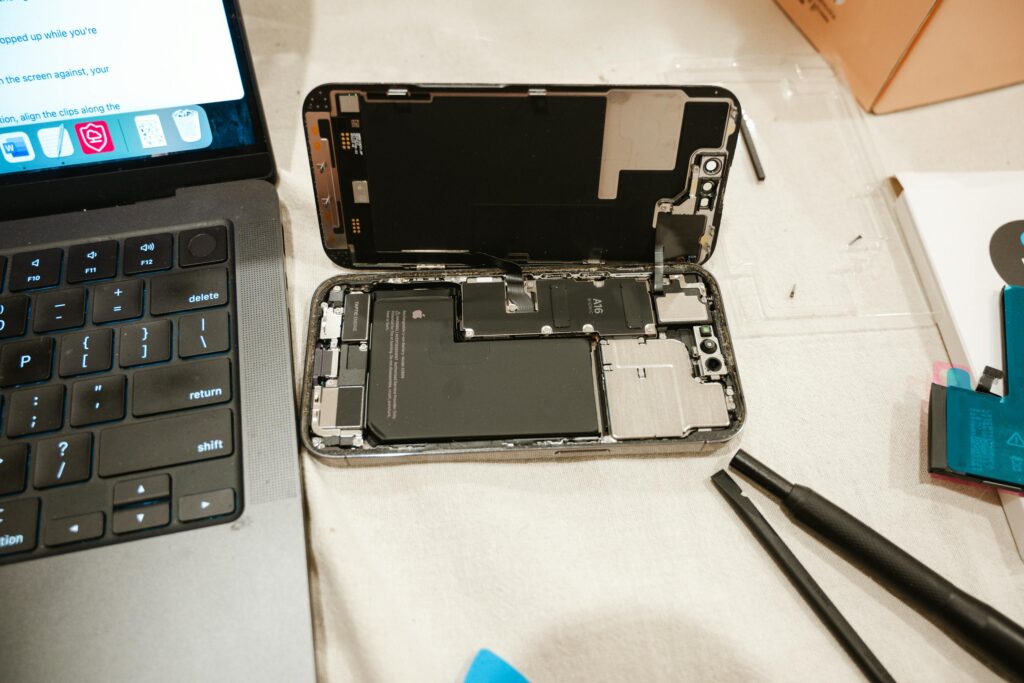
We all know the exact moment it happens. You’ve had your high-end device for about two years, and suddenly it’s gasping for air by lunchtime. Before you give in to the glossy ads for this year’s new model, you should consider the reality of flagship smartphone repair. Is your phone actually “dying,” or are you just falling for the most well-engineered trap of the 21st century? Let’s dismantle the myth.
The reality is an uncomfortable mix of basic physics and the aggressive financial tactics of Big Tech. Let’s dive in.
1. The Chemistry of Betrayal: Why Your Battery Physically Degrades
To be fair to the tech giants, it’s not all a conspiracy. There is a hard physical limit that modern technology hasn’t quite bypassed yet: Lithium-ion chemistry.
The batteries inside our devices aren’t static gas tanks; they are complex chemical sponges. Every time you drain your phone and charge it back up, you consume what is known as a “charge cycle.”
- Most modern smartphones are engineered to retain approximately 80% of their original capacity after 500 charge cycles.
- For the average user, 500 cycles translate to roughly 18 to 24 months of daily use.
As the lithium inside the cell oxidizes over time, the battery doesn’t just lose its ability to store energy; it loses its ability to deliver it quickly. When your processor demands a sudden spike of power to open a heavy game, an old battery simply can’t push the voltage fast enough. If the phone tries to draw power that isn’t there, it abruptly shuts down to protect the hardware.
The Verdict: Yes, your battery is physically dying. That’s just science.
2. The Silent Chokehold: Software Throttling
Here is where things get murky, and where Big Tech starts playing with your perception.
Because aged batteries can’t handle peak power demands, operating systems (both iOS and Android) employ aggressive power-management algorithms. Remember Apple’s infamous “Batterygate” in 2017? To prevent older phones from randomly shutting down, the software deliberately throttled the CPU performance.
While brands are technically more transparent about this today (hiding behind “Battery Health” menus), the core issue remains:
- Heavy OS Updates: The newest operating system is optimized for the silicon in the latest model, not your three-year-old chip.
- Shadow Bloatware: Modern apps demand more resources. A simple UI overhaul on a messaging app now requires more background processing, draining your weakened battery at a ferocious rate.
The psychological result is brutal: your phone feels like garbage. It isn’t; it’s just being choked by the software to keep the battery on life support.
3. The Illusion of the “Unrepairable” Device
If you own a car and the tires wear out, you don’t throw the car away and buy a new one; you buy new tires. So why don’t we do the same with our $1,000 pocket computers?
The answer is simple: The industry has designed modern phones so you won’t want to repair them, even when a standard flagship smartphone repair is vastly cheaper.
- Industrial Adhesives: Batteries are no longer accessible. They are glued down into an aluminum chassis, sealed behind fragile, expensive glass.
- Parts Pairing (Serialization): Companies now pair the serial number of the battery to the motherboard via software. Install a new battery without their proprietary calibration software, and your phone will bombard you with warning notifications.
- Psychological Pricing: Replacing a battery officially usually costs between $70 and $100. When you take it to the store, the rep will inevitably say: “Well, with the repair cost plus your trade-in value, you could just walk out with the new model for only $30 a month.”
Boom. You just fell in the trap. You traded in a perfectly functional computer because of a chemical consumable that costs less than $10 to manufacture.
4. How to Hack the System and Save Your Wallet
You don’t have to accept this cycle. If your screen is intact, the cameras still take great photos, and you have enough storage, here is how you break out of the “New Phone” trap:
- Audit Your Battery Health: Dive into your battery settings. If your maximum capacity is hovering around 80% or below, the battery is your only bottleneck.
- Trim the Software Fat: Turn off Background App Refresh for everything except essential messaging apps. Restrict location tracking to “Only While Using the App.”
- The $80 Lifeline: Invest in an official battery replacement or take it to a highly reputable shop specializing in flagship smartphone repair. Spending $80 today prevents you from spending $1,000 over the next two years.
Once that fresh lithium cell is installed, your OS will stop throttling the CPU. The speed, the responsiveness, and the screen-on time will instantly return to day-one levels.
The Bottom Line
Your phone doesn’t hate you, but the manufacturer’s board of directors absolutely loves the idea of you feeling like your hardware is obsolete. Battery degradation is an unavoidable law of physics, but the pressure to replace rather than repair is purely a market construct.
Next time your phone hits 10% before sunset, take a deep breath. It’s just chemistry—not the end of your device’s life.
