
We all make the same gestures hundreds of times a day: we swipe to scroll, double-tap to like a photo, or pinch the screen to zoom in. It feels completely mundane, almost like magic. But if you want to know exactly how touchscreens work, you need to look closer. How is it possible that a simple piece of glass knows exactly what you want to do with millimeter precision?
Today, we are going to dive deep into the guts of your mobile phone to uncover one of the most fascinating technological curiosities of our daily lives. Get ready, because what lies beneath that glass isn’t just a window to the digital world; it is a microscopic sandwich of pure engineering.
From Pressure to Touch: How Touchscreens Work in Older Devices
Before we arrived at the sleek modern smartphones we use today, there was another technology. If you owned an old-school PDA, an early car GPS, or a classic Nintendo DS, understanding how touchscreens work meant looking at resistive technology.
These older screens were made of two flexible layers of plastic or glass coated with a conductive material, separated by a microscopic gap of air. When you pressed down on the screen, those two layers were physically pushed together. This physical contact closed an electrical circuit, and the device calculated the coordinates of the pressure. While they were incredibly cheap to manufacture, they didn’t support multi-touch and the screen visibility under direct sunlight was quite poor.
The Human Body as a Battery: The Capacitive Revolution
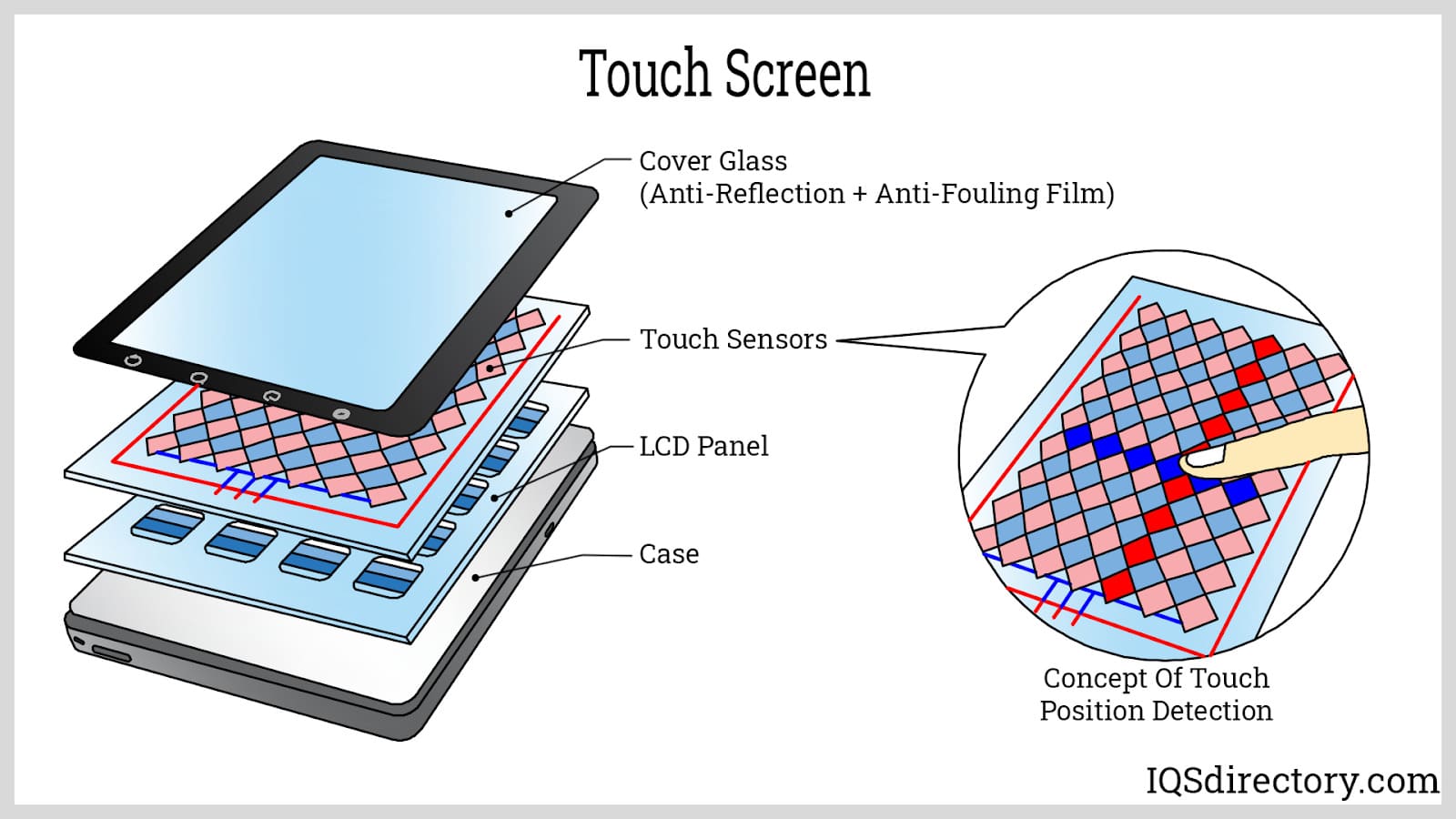 Image source: www.iqsdirectory.com
The real magic that explains how touchscreens work in almost 100% of modern smartphones and tablets is based on a fascinating physical principle: capacitive technology. Your modern screen doesn’t react to the pressure of your finger; it reacts to the electricity in your body.
The human body is an excellent conductor of electricity. Modern screens feature a microscopic grid made of wires invisible to the naked eye (as seen in the diagram above). These ultra-thin wires, typically made of a transparent conductive material called Indium Tin Oxide (ITO), carry a continuous electrical current. This creates a uniform electrostatic field across the entire surface of your screen.
The Moment of Contact
When you bring your bare finger close to the screen, your finger acts as an energy “thief.” A minuscule amount of the electrical charge from that invisible grid transfers to your finger. The highly sensitive sensors inside the phone notice this tiny voltage drop.
A controller chip detects exactly where on the grid the electrical current has decreased. Instantly, it calculates the X and Y coordinates of that alteration and tells the main processor: “Hey, the user just tapped the camera icon.” All of this happens in just a couple of milliseconds!
The Winter Drama: Gloves and Electrostatic Fields
If you are still wondering how touchscreens work in the cold, the answer lies in that same electrostatic field. Traditional winter gloves made of wool or leather are insulating materials. They do not conduct electricity.
When you try to use your phone wearing a thick glove, the fabric physically blocks the transfer of electrons between your body and the screen. The electrostatic field doesn’t suffer any alteration, and the sensor detects nothing. It’s as if you were poking it with a piece of dry wood.
The Solution is in the Accessories
Fortunately, the tech industry always finds a workaround. If you check out our latest winter accessories, you will see special gloves designed specifically for touchscreens.
They have tiny threads of conductive materials woven right into the fingertips. These threads act as a bridge, channeling your body’s natural electricity straight onto the glass, keeping your hands toasty warm while tricking the screen.
When the Magic Breaks: The Protective Glass
Given this delicate electrostatic balance, it is easy to understand why a cracked screen starts to malfunction. When the outer glass breaks, it often severs that invisible grid of conductive wires underneath, causing “ghost touches” or dead zones.
This is why keeping your front panel in good condition is vital. Protecting it with a tempered glass screen protector is the best first step. However, if you’ve already had an accident, remember that it is always more economical to find high-quality replacement parts to give your device a second life.
The Future at Our Fingertips
As we continue to explore how touchscreens work, the technology evolves rapidly. We are already seeing high-end phones that can detect your finger even underwater, utilizing ultrasonic sensors.
The next time you unlock your phone, take a brief second to appreciate that invisible dance of electrons. You are physically interacting with electrical fields on a nanoscale level. Isn’t the technology we carry in our pockets absolutely incredible?
